
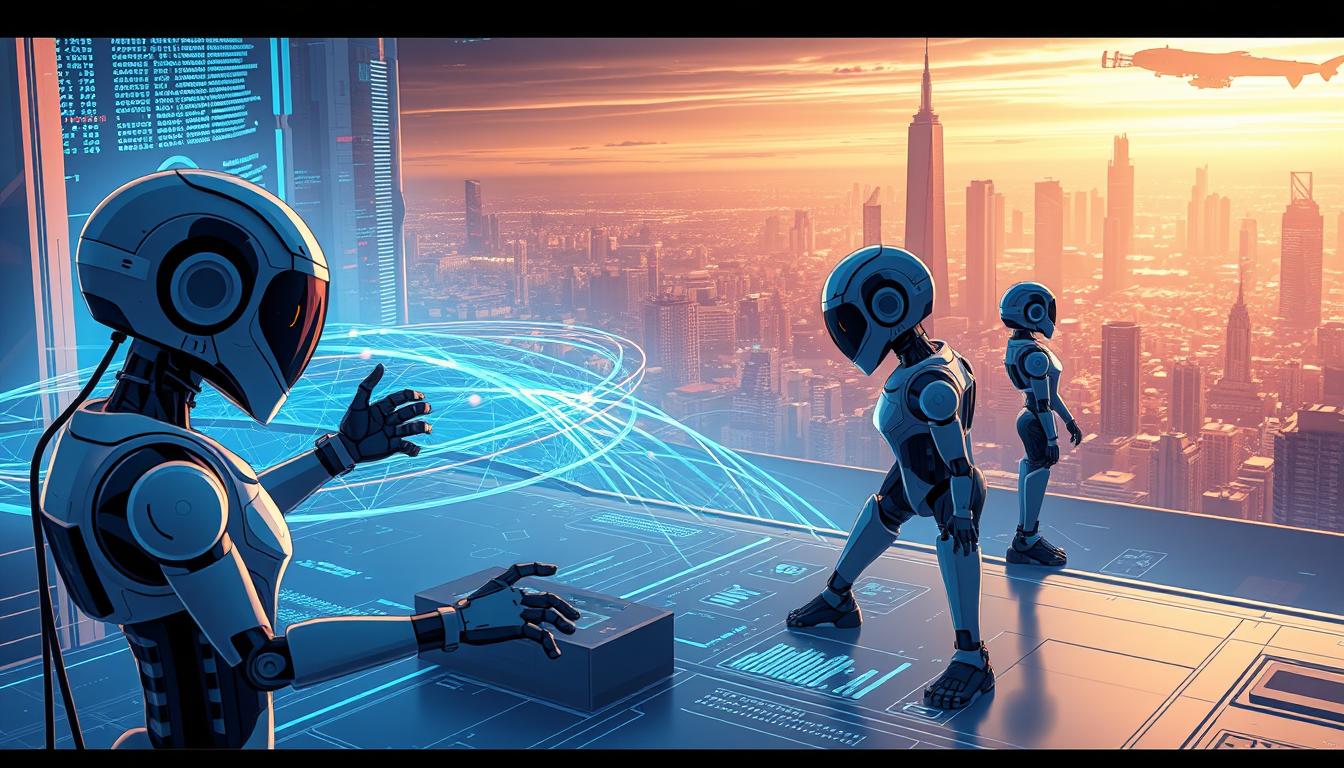
Did you know that intelligent agents are changing how businesses work? At ReadySpace, we help businesses grow with cloud solutions and expert help. We use AI to make big changes. Intelligent agents are software that use AI to do tasks for us. They can plan, remember, and make decisions on their own.
These agents can act on their own, learn, and change. They are key to modern AI. As intelligent agent applications grow, they’re changing many industries. We’re seeing a big shift in technology because of them.
Key Takeaways
- Intelligent agents are software systems that use AI to pursue goals and complete tasks.
- They show reasoning, planning, and memory, with autonomy to make decisions.
- Intelligent agents are revolutionizing business operations across industries.
- ReadySpace empowers businesses with cloud solutions and expert support.
- Intelligent agent applications are driving transformation in the technology landscape.
What is an Intelligent Agent?
Intelligent agents are advanced software that see their world and act to reach their goals. They work on their own, making choices based on what they see and what they’ve learned before.
Definition and Characteristics
These agents have key traits like autonomy, goal-oriented behavior, perception, rationality, proactivity, continuous learning, adaptability, and collaboration. These traits help them do complex tasks by themselves. For more on AI agents, check out AWS’s explanation on AI agents.
Being autonomous means they decide based on their programming and what they sense around them. This is key for AI to handle changes without needing a human to tell it what to do.
Types of Intelligent Agents
There are many kinds of intelligent agents, each with its own special features and uses. Here are a few:
- Simple Reflex Agents: These agents decide based on what’s happening right now, without looking back.
- Model-Based Reflex Agents: These agents keep an internal map of their world, helping them make better choices.
- Goal-Based Agents: These agents have clear goals and make choices to reach them.
- Utility-Based Agents: These agents pick options based on how good or bad they think they’ll be.
- Learning Agents: These agents get better over time by learning from their experiences.
Knowing about these different types of agents is key for making AI systems that can really interact and adapt. By using these agents, businesses can get ahead with the latest tech.
Historical Development of Intelligent Agents
The history of intelligent agents is filled with important milestones. These moments are key to understanding why intelligent agents are so important in AI today.
Early Concepts in AI
In the 1950s and 1960s, the idea of intelligent agents started to form. The Dartmouth Summer Research Project on Artificial Intelligence in 1956 was a turning point. It’s often seen as the start of AI as we know it.
Researchers back then wanted to make machines that could think like humans. This idea was the first step towards creating intelligent agents.
As AI grew, so did the idea of intelligent agents. They were seen as machines that could act on their own and interact with their surroundings. These traits are key to what makes intelligent agents work. They have been improved over time through many intelligent agent examples and uses.
Milestones in Agent Technology
The 1980s saw the rise of expert systems. These systems were made to think like human experts in certain areas. They were some of the first real uses of intelligent agent technology.
- The 1990s brought machine learning, which helped agents get better over time by learning from data.
- Today, with deep learning and natural language processing, we have agents that can do complex tasks. Examples include personal assistants and self-driving cars.
These advancements show how intelligent agents are vital in AI. They show how versatile and powerful they can be. As we keep exploring what intelligent agents can do, we’ll see even more amazing uses in the future.
For the latest deals on AI solutions and expert support, feel free to Whatsapp us at +601120940370.
Key Components of Intelligent Agents
Understanding intelligent agents is key to seeing their role in AI. They are not simple programs but complex systems. They work through a mix of important elements.
These parts help them see their world, act on it, and make choices that meet their goals.
Perception
Perception is how intelligent agents get info about their world. They use sensors or data inputs. For example, a self-driving car uses cameras and radar to know its surroundings.
Experts say, “The ability to see its environment is key for an intelligent agent to act smartly.” This shows how vital perception is for these agents.
Action
Action is what an intelligent agent does to reach its goals. This can be moving physically, like a robot, or acting digitally, like a chatbot. The right actions let agents do what they’re meant to do.
In customer service, agents can answer simple questions. This lets humans handle harder issues. It makes service better and happier for customers.
| Component | Function | Example |
|---|---|---|
| Perception | Gathering environmental information | Self-driving car sensors |
| Action | Taking steps to achieve goals | Robot navigation, chatbot responses |
| Decision-Making | Selecting the best course of action | Algorithm-driven decision processes |
Decision-Making
Decision-making is the heart of intelligent agents. It’s about choosing the best action based on what they know. This is done through algorithms and models that look at data and predict results.
In finance, agents can look at market trends and decide on investments. This is super helpful for businesses wanting to improve their money strategies.
To learn more about how intelligent agents are changing industries, WhatsApp us at +601120940370.
Applications of Intelligent Agents in Various Industries
Intelligent agents are changing how industries work. They can analyze data, make decisions, and do tasks on their own. This is making businesses change how they operate.
Healthcare
In healthcare, intelligent agents help with diagnosis, patient care, and personalized medicine. They look at medical data to help doctors make better diagnoses and treatment plans. For example, they can check medical images for abnormalities.
Finance
The finance world uses intelligent agents for risk analysis, managing portfolios, and finding fraud. They look at lots of financial data to spot trends and risks. This helps financial places make smart choices. For more on how intelligent agents work in AI, check out GeeksforGeeks.
Manufacturing
In manufacturing, intelligent agents help with predictive maintenance, quality control, and improving supply chains. They can predict when equipment might fail, so maintenance can happen before it does. This makes things run smoother and saves money.
Customer Service
Intelligent agents are also changing customer service. They offer 24/7 help through chatbots and virtual assistants. They can answer questions, solve problems, and even give personalized advice. This makes customers happier.
We’re helping businesses by using intelligent agents in many fields. If you want to find deals on intelligent agent solutions, text us at +601120940370.
Intelligent Agents vs. Traditional Software
Intelligent agents are more advanced than traditional software. They can learn and adapt, unlike traditional software that follows set rules.
We’ll look at how intelligent agents differ from traditional software. They can get better over time, making them very useful in many areas.
Adaptability
Intelligent agents can change how they act in new situations. This is different from traditional software, which sticks to its rules.
Key aspects of adaptability include:
- Responding to new information
- Adjusting to changing environments
- Improving performance over time
In customer service, for example, intelligent agents can handle different questions better. This is a big plus over traditional software, which might not know how to answer unexpected questions.
Self-Learning Capabilities
Intelligent agents can also learn on their own. They use machine learning to get better without being told how to.
The importance of self-learning capabilities can be seen in several areas:
| Area | Traditional Software | Intelligent Agents |
|---|---|---|
| Problem-Solving | Follows pre-programmed rules | Adapts and learns from experiences |
| Customer Service | Limited to predefined responses | Provides personalized and dynamic responses |
| Data Analysis | Analyzes data based on set parameters | Identifies patterns and makes predictions |
Intelligent agents can solve problems in a more advanced way than traditional software. This is really helpful in complex situations where they can learn and adapt.
Want to know more about how intelligent agents are changing industries? WhatsApp us at +601120940370 for the latest updates.
The Role of Machine Learning in Intelligent Agents
Machine learning is key for intelligent agents to learn and make smart choices. It helps these agents get better with time. They can handle new situations and places better.
Machine learning is a part of artificial intelligence. It trains algorithms to learn from data. For intelligent agents, it boosts their ability to make decisions. This makes them work well in complex settings.
Supervised vs. Unsupervised Learning
Machine learning in intelligent agents includes supervised and unsupervised learning. Supervised learning uses labeled data to train models. This lets the agent predict outcomes. Unsupervised learning works with unlabeled data. It helps the agent find patterns and relationships without knowing the outcome.
- Supervised learning is good for tasks like image classification and speech recognition.
- Unsupervised learning is great for tasks like clustering and anomaly detection.
The choice between supervised and unsupervised learning depends on the task and data. For example, in healthcare, supervised learning can diagnose diseases from images. Unsupervised learning can find health risks in patient data.
Reinforcement Learning
Reinforcement learning is also important for intelligent agents. It trains the agent by rewarding or penalizing it for its actions. This way, the agent learns through trying and failing.
In robotics, reinforcement learning can teach a robot to navigate a maze. It rewards the robot for reaching the exit and punishes it for hitting things.
By using different machine learning types, intelligent agents can do many tasks. From simple tasks to complex decisions. As machine learning grows, intelligent agents will get smarter and more capable.
To keep up with the latest in intelligent agents and machine learning, WhatsApp us at +601120940370. Get the latest deals.
Ethical Considerations for Intelligent Agents
Intelligent agents are becoming a big part of our lives. We need to think about their ethics more than ever. These agents raise important questions that we must answer to make them work well in society.
Transparency and Accountability
Transparency and accountability are key for intelligent agents. They should explain their decisions clearly. We can use open algorithms and keep records of their choices.
In healthcare, for example, being open is key to trust. It helps patients and doctors feel secure.
Being accountable means these agents must face consequences for their actions. We need rules for how they are made and used. IBM’s insights on AI agent ethics show how important this is.
Key considerations for transparency and accountability include:
- Implementing transparent algorithms
- Maintaining detailed records of decision-making processes
- Establishing clear guidelines and regulations
Bias and Fairness
Bias and fairness are also big issues. Bias can come from the data used to train these agents. We need to use diverse data and algorithms that spot and fix bias.
Being fair is not just right; it’s necessary for these agents to work well. Unfair agents can harm trust and reputation. By focusing on fairness, we make agents that are both effective and just.
Strategies for addressing bias and ensuring fairness include:
- Using diverse and representative training data
- Implementing fairness-aware algorithms
- Regularly auditing and testing agents for bias
By tackling these ethical issues, we can make sure intelligent agents are used wisely. As we add them to more areas, focusing on transparency, accountability, fairness, and bias is essential.
Challenges Faced by Intelligent Agents
Intelligent agents come with their own set of challenges. These include technical hurdles and real-world issues. It’s important to tackle these to ensure their success.
Technical Limitations
Intelligent agents face technical issues that affect their performance. One big problem is their need for high-quality data. Without it, they can’t learn or make good decisions.
For example, a customer service agent might not get language or cultural references right. This is because it hasn’t seen enough diverse data.
Another issue is vulnerability to bias. Agents can pick up biases from their training data. This can lead to unfair outcomes. For instance, a biased agent in hiring might unfairly judge some applicants.
Real-World Implementation
Putting intelligent agents into real-world use is tough. They need robust infrastructure to work well. This can be a problem for organizations with limited IT resources.
Also, using intelligent agents raises societal concerns. For example, in self-driving cars, who’s to blame in an accident? In healthcare, they must follow strict privacy rules. These issues need to be addressed to gain public trust.
To tackle these challenges, we need a broad approach. This includes more research, better testing, and working together with industry and regulators. This way, we can fully use intelligent agents and boost innovation.
For the latest on intelligent agents, WhatsApp us at +601120940370 for the latest deals.
Future Trends in Intelligent Agents
The next generation of intelligent agents will seamlessly work with smart devices and be found in more autonomous systems. They will become more advanced, leading to new innovations in many fields.
Advancements in Smart Technologies
Intelligent agents will change how we use smart technologies. They will work with Internet of Things (IoT) devices to make processes more efficient and automated. For example, in smart homes, they can manage lighting, temperature, and security, making our homes more comfortable and safe.
These agents also make smart devices more useful. As an article on Medium points out, they are making our lives and work more personalized and efficient.
Proliferation of Autonomous Systems
Intelligent agents will also impact autonomous systems like self-driving cars and drones. These systems need agents to make quick decisions, ensuring they operate safely and efficiently. For instance, in cars, agents help develop systems that can handle different driving situations.
The table below shows some key trends and uses of intelligent agents in smart technologies and autonomous systems:
| Trend | Application | Industry |
|---|---|---|
| Integration with IoT | Smart Home Automation | Consumer Electronics |
| Autonomous Systems | Self-Driving Cars | Automotive |
| Enhanced Decision-Making | Predictive Maintenance | Manufacturing |
The future of intelligent agents is both exciting and rapidly changing. We look forward to exploring these trends further. They will help businesses use cloud solutions and get expert support. For the latest on intelligent agent applications, Whatsapp us at +601120940370 for the latest updates.
How Intelligent Agents Impact Daily Life
Intelligent agents are changing how we live and work. They are being used in many parts of our lives. This makes things more efficient and automated.
Smart Home Devices
Smart home devices are a big example of intelligent agent examples. Devices like Amazon Echo and Google Home are changing how we control our homes. They can understand voice commands, play music, and even control other smart devices.
For example, you can turn on lights or adjust the thermostat with just a voice command. This makes life easier and helps save energy and keep our homes safe.
Personal Assistants
Intelligent agents also play a big role in personal assistants. Apps like Siri, Google Assistant, and Cortana are integral to our daily routines. They help us manage our time, send messages, and find information quickly.
These assistants show off intelligent agent characteristics in artificial intelligence. They can understand us, learn our likes, and do tasks for us. They are essential in our daily lives.
To learn more about intelligent agents and their uses, check out BrainPod AI for detailed information.
The Significance of Intelligent Agents in AI Research
Intelligent agents are key in AI research, leading to big steps forward. Knowing what an intelligent agent is helps us see how they can change many industries.
Creating intelligent agents requires teamwork from computer science, psychology, and philosophy. This mix helps make AI systems smarter. They can now interact better and make smart choices.
Advancements in AI Development
Intelligent agents are important because they can handle complex tasks. This has led to big improvements in customer service, healthcare, and finance. For more on AI agents, check out IBM’s AI agents page.
As we learn more about intelligent agents, we’ll see even more creative solutions. These will help businesses grow and make our lives better. Using intelligent agents, companies can stay ahead and reach their goals faster.
FAQ
What is an intelligent agent in AI?
An intelligent agent is a computer system that can do things on its own. It makes decisions and learns from new situations. It uses AI techniques like machine learning.
What are the different types of intelligent agents?
There are many types of intelligent agents. These include simple reflex agents and goal-based agents. Each type has its own features and uses.
How do intelligent agents differ from traditional software?
Intelligent agents can adapt and learn. They make decisions based on new information. Traditional software just follows rules it was given.
What is the role of machine learning in intelligent agents?
Machine learning is key for intelligent agents. It helps them learn and get better over time. They use different types of learning, like supervised and reinforcement learning.
What are some of the applications of intelligent agents?
Intelligent agents are used in many fields. In healthcare, they help with diagnosis and patient care. In finance, they analyze risks and manage portfolios. In manufacturing, they predict maintenance needs and check quality.
What are some of the challenges faced by intelligent agents?
Intelligent agents face several challenges. They need high-quality data to work well. They also face challenges in real-world use, like setting up strong systems and dealing with societal issues.
How do intelligent agents impact daily life?
Intelligent agents change our daily lives. They make our homes smarter and help us manage our lives. They are in personal assistants and more.
What are some of the future trends in intelligent agents?
The future looks bright for intelligent agents. They will work with smart technologies like IoT devices. They will also be in autonomous systems, like self-driving cars, changing how we live and work.
What are the ethical considerations for intelligent agents?
Making and using intelligent agents raises big questions. We need to be clear and fair. We must make sure they are used right and don’t harm anyone.
How do intelligent agents contribute to AI research?
Intelligent agents are key to AI research. They drive new ideas and help make AI systems better. They use knowledge from computer science, psychology, and philosophy.
There are no comments.